The short answer#
Start with a bounded document workflow, such as drafting maintenance handovers for review. Choose a task with approved sources, identifiable equipment and a reviewer who can check the result before use. Expand only when accepted outputs save time after checking, correction and document upkeep, with plant operations kept outside the pilot's authority.
Start where a supervisor can check the work#
For a manufacturing company choosing its first Gen AI pilot, a useful starting point is a maintenance handover draft for one production area. Give the assistant selected work-order records and approved reference documents. Ask it to organise recorded facts: which asset is affected, what was observed, what work was recorded and which issues remain open.
The maintenance supervisor checks the draft against those records before it becomes the handover. The assistant cannot close work orders, declare equipment fit to run or issue repair instructions. Missing information stays missing and goes back to the responsible person.
This gives you a testable business question: can the supervisor prepare an accurate handover faster, including the time spent checking it? It also gives you a small enough scope to discover whether the records are usable.
That is our recommended starting point when handover preparation is a recurring burden and the records have an owner. If staff already produce accurate handovers quickly, choose another documented bottleneck. If the source records are unreliable, repair that process before adding generated summaries.
Compare the work, the evidence and the consequence#
A compelling demonstration is only one input to a pilot decision. Compare candidates by the cost of an error, the evidence available and how easily a person can verify the output.
| Candidate | Useful first scope | Evidence needed before approval | Boundary for the pilot |
|---|---|---|---|
| Maintenance handover drafting | Summarise recorded events and outstanding issues | Work orders with asset identity, timestamps, status and an accountable reviewer | Supervisor approves; no invented diagnosis, completed work or clearance to operate |
| Equipment-document lookup | Find the approved document and relevant passage for a planner | Maintained document register, asset applicability, revision and source location | Show the source; do not generate a new repair procedure |
| Quality investigation support | Assemble inspection records into a draft investigation pack | Traceable batch records, measurements and quality review | No product release, changed limits or final disposition |
| Predictive maintenance | Explain results from a separately tested diagnostic or prediction system | Relevant equipment data, verified predictions and engineering ownership | A fluent explanation alone cannot justify a maintenance decision |
| Machine setting or control changes | Consider separately after an engineering and operational assessment | Validated control design, change process and accountable plant authority | Exclude from this first document pilot |
Maintenance records and equipment signals are different evidence sources. NIST's manufacturing maintenance overview, updated in January 2022, describes both human-created work orders and equipment-generated data. For pilot selection, an assistant that summarises past repairs has not shown it can predict a failure.
Choose the document task only if it still saves time after checking. A task that needs a senior engineer to reconstruct every answer may have too little remaining benefit.
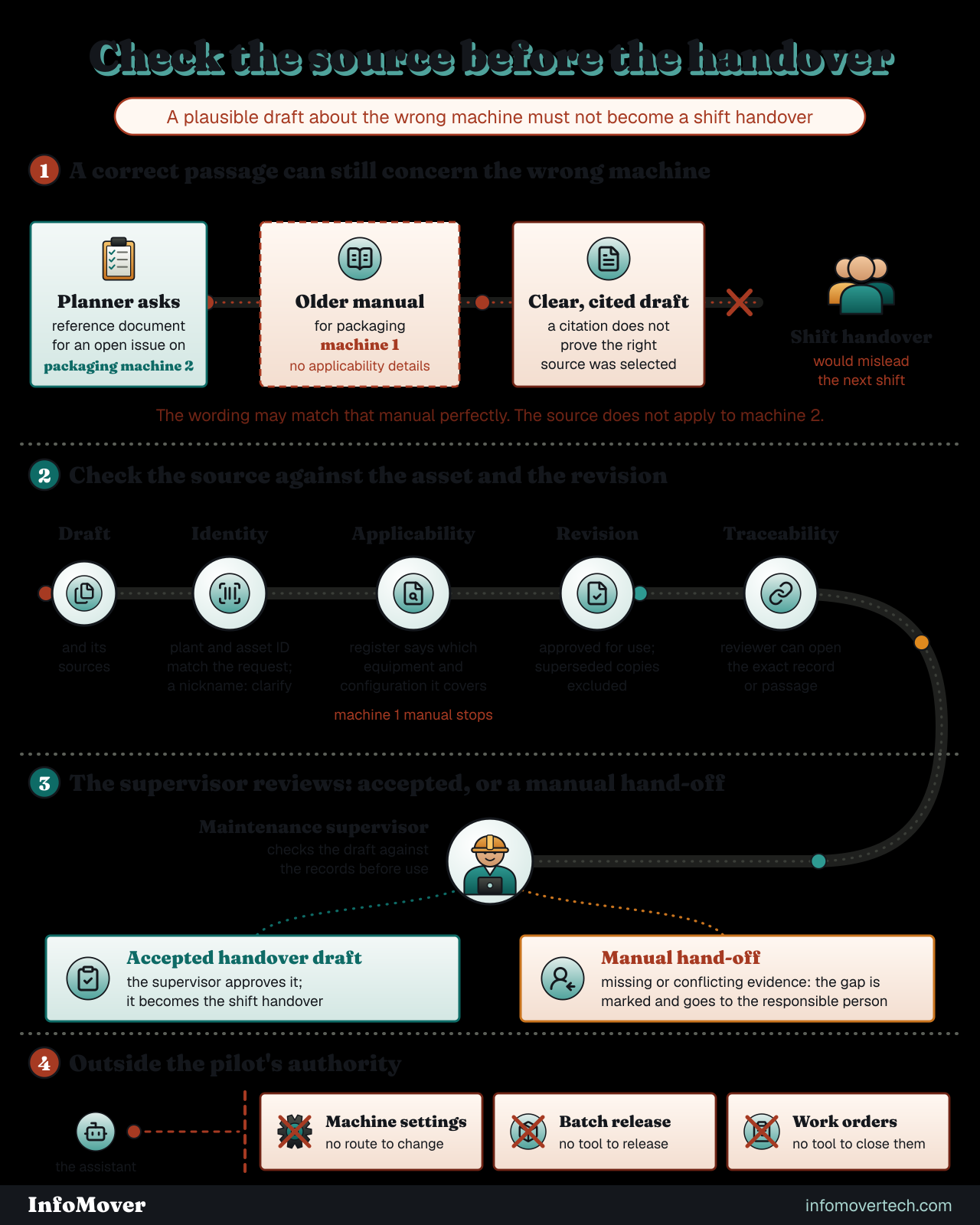
A correct passage can still concern the wrong machine#
Consider a hypothetical factory with two similar packaging machines. A planner asks for the reference document for an open maintenance issue on the second machine. The assistant finds a clear passage in an older manual for the first machine and presents it without the applicability details.
The wording may match that manual perfectly. The answer still fails the business task because the source does not apply to the requested asset. A citation gives the reviewer something to inspect; it does not establish that the right source was selected.
In this hypothetical, if the mismatch reaches the next shift and staff rely on it, they could prepare the wrong maintenance work, then spend more time finding the right document and repeating the planning. The line could remain stopped during that rework, and any action already taken could need a safety review before work continues.
Before the assistant produces a usable draft, require the application to check:
- Identity: the plant and asset identifier match the request. An ambiguous machine nickname triggers clarification.
- Applicability: the document register identifies which equipment and configuration the document covers.
- Revision: the source is approved for use, with superseded copies excluded from the permitted collection.
- Traceability: the reviewer can open the exact source record or passage, including its date and revision where relevant.
- Missing or conflicting evidence: the output marks the gap and routes the task to a person instead of filling it with a plausible explanation.
These are requirements we recommend for the pilot. The team must demonstrate them with deliberately confusing examples, including an outdated manual and two assets with similar names.
NIST's July 2024 Generative AI Profile identifies the risk of confidently expressed false information. For this workflow, require both source checks and a supervisor's review; well-written text is not proof that an entry is right.
Keep the pilot's authority narrow#
A document assistant still influences people. Even without machine access, an incorrect handover can mislead the next shift. Keep existing operating procedures in force, label outputs as drafts and give reviewers enough time and source access to catch errors.
Also prevent the pilot from changing operational systems. Use a controlled document collection and permitted record extracts, with access limited to the user's role and production area. Give it no credentials or network route to change machine settings, and no tool that can release a batch or close a maintenance task. Have the IT and plant owners verify those boundaries.
NIST's September 2023 OT security guide treats plant technology as having particular performance, reliability and safety requirements. Our recommendation is to keep the first document pilot outside equipment control. That boundary reduces its authority; it does not certify the assistant as safe for operational decisions.
Require explicit treatment of confidential drawings, supplier documents and shift records before uploading them. The owner should approve the collection, permitted users, provider data handling and retention. A successful trial in one area does not grant access to every plant's records.
Count the checking time before claiming savings#
Use completed, accepted work as the unit of value. The following is a hypothetical planning example, not a manufacturing benchmark or an achieved result. Assume a maintenance desk prepares 800 handover entries a month, taking 12 minutes per entry manually.
For the assisted process, assume every entry takes six minutes to prepare and check. Of those entries, 20% are rejected and then take the full 12 minutes to prepare manually. Allow another ten hours a month for document upkeep and operating the service.
| Monthly work | Calculation | Hours |
|---|---|---|
| Existing manual process | 800 × 12 minutes ÷ 60 | 160 |
| Assisted preparation and checking, all entries | 800 × 6 minutes ÷ 60 | 80 |
| Manual fallback for rejected entries | 160 × 12 minutes ÷ 60 | 32 |
| Document upkeep and service operation | Assumed allowance | 10 |
| Total assisted process | 80 + 32 + 10 | 122 |
| Time released | 160 − 122 | 38 |
The assumed time released is about 24% of the baseline. If half the entries instead need manual fallback, the assisted process takes 80 + 80 + 10 = 170 hours, ten hours more than the baseline. Checking time and rejection rate can reverse the decision.
Replace every assumption with observed pilot data. Count source collection, corrections, failed attempts and fallback consistently in both processes. Keep quality constant: a faster summary that drops an unresolved fault does not count as accepted work.
Released staff time becomes cash savings only if you can remove an expense; otherwise describe the capacity it frees and who will use it. The investment decision also needs build or subscription costs, hosting, model usage, security and support. Use the Gen AI application cost framework to assemble that wider budget.
What this means for you#
Approve a pilot with one production area, one task and one accountable operations owner. Before it starts, agree the manual baseline, acceptance criteria, test cases and conditions for pausing use.
Test ordinary entries alongside the cases most likely to mislead the next shift: missing asset IDs, duplicate machine names, changed status, conflicting records, superseded documents and unresolved faults. The expected output may be a request for clarification or a manual hand-off. Record those separately from confident wrong answers and from useful completed drafts.
Use three gates before expansion:
- Evidence and quality: reviewers can trace material statements to the right records. Known wrong-asset, wrong-revision and omitted-open-fault cases must be corrected before rollout. No errors in a small sample is a reason for further controlled testing, not proof of universal reliability.
- Operating control: named owners maintain the sources and review the outputs. Verify access boundaries, logging, manual fallback and the ability to pause new work. An untraceable operational claim or access outside the approved scope should stop the trial for investigation.
- Business value: representative usage saves enough time after checking and upkeep to justify the full cost. State what additional work the released capacity will support.
Buying an assistant may reduce implementation work, but the vendor still needs to demonstrate these gates using your records. Building a custom integration may give you closer control over source selection and workflow; it also gives you responsibility for maintaining it. Ask a consulting partner to prove the uncertain parts on the bounded task before approving a wider assignment.
Expand one dimension at a time: another asset family, another document collection or another task. Each change brings new applicability and review questions. Moving into equipment control requires its own engineering decision.
Questions to ask before approving the pilot#
- Which recurring document task consumes enough time to make this worthwhile?
- Who owns the asset identities, approved revisions and source records?
- Can the supervisor verify every material statement without recreating the whole task?
- What happens when a record is missing, outdated or conflicts with another record?
- Which actions and systems are outside the assistant's authority, and how have we tested that boundary?
- How much time remains saved after review, rejected drafts and ongoing upkeep?
- Who can pause the trial, and how does the next shift continue manually?
For a consulting engagement to select one factory workflow and test these assumptions, Discuss your project.