The short answer#
Change estimates, pricing and staffing when your own delivery evidence shows that accepted work takes less total effort at the required quality. Measure implementation, review, testing, integration and rework together, then revise commitments for the work types and contracts where the improvement holds. Begin with a bounded delivery cohort before promising a firm-wide productivity discount or reducing role coverage.
A coding gain needs a delivery boundary#
For an IT services firm, an AI productivity claim becomes a commercial commitment when it changes a proposal, a delivery date or a team allocation. Before accepting that commitment, ask what the measurement includes.
Code written is an intermediate output. The client accepts a change that meets agreed behaviour, integrates with the existing system and satisfies the release criteria. Your estimate needs to cover the effort required to reach that point, including work transferred to reviewers or testers.
Published research gives useful reasons to measure locally. A June 2025 study summarised by Microsoft Research reported 26.08% more completed tasks in a pooled analysis of three field experiments covering 4,867 developers. That is a result for those settings and that output measure; it does not establish an equivalent reduction in project effort.
In a different setting, METR's July 2025 study found that experienced contributors working in familiar open-source repositories took 19% longer when early-2025 AI tools were allowed. Its February 2026 update described evidence suggesting later improvement, while warning that selection effects made the size of the increase difficult to establish.
These are dated observations with different participants, tasks and methods. The commercial inference is to test your delivery process before putting a saving into a contract. Neither result supplies a universal multiplier for an estimate made today.
Estimate the whole accepted change#
Keep the scope and acceptance criteria fixed while comparing effort. Otherwise a smaller change, an easier repository or deferred testing can appear to be a productivity improvement.
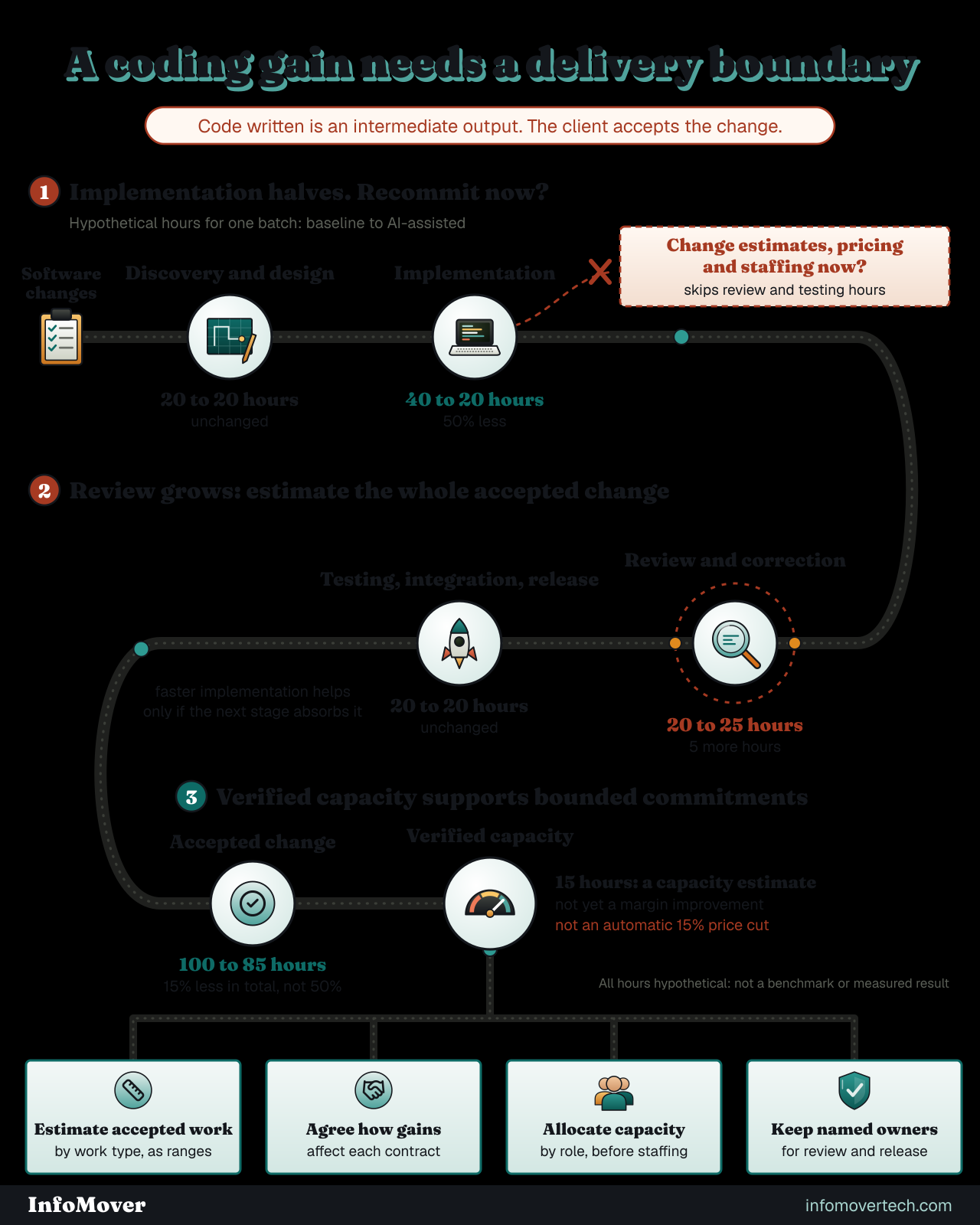
Consider this hypothetical batch of software changes. Every hour below is an illustrative planning assumption, not a benchmark, client result or InfoMover performance claim. Both columns assume the same accepted scope and quality; the AI-assisted column includes the team's prompting and checking time within its relevant activities.
| Activity | Baseline effort | AI-assisted effort |
|---|---|---|
| Discovery, clarification and design | 20 hours | 20 hours |
| Implementation | 40 hours | 20 hours |
| Review and correction before testing | 20 hours | 25 hours |
| Testing, integration and release | 20 hours | 20 hours |
| Total delivery effort | 100 hours | 85 hours |
Implementation effort falls by 50%, but total effort falls by 15%: the team saves 20 implementation hours and spends five additional hours on review and correction. Each hour belongs to one row; correction already counted in review must not also appear as a separate rework allowance.
The 15-hour difference is a capacity estimate for this batch. It is not yet a margin improvement. To estimate cost, multiply each role's hours by its own internal cost and include tools, setup, training and continuing support. Five additional senior review hours may cost more than five implementation hours. Keep one-off adoption work separate from recurring delivery costs.
Nor does 15% less effort promise a 15% shorter schedule. Client decisions, test environments and reviewer availability can still determine elapsed time. Record calendar time from ready-to-start to acceptance separately from the sum of working hours.
If a defect appears after acceptance, attribute the resulting correction effort back to the cohort during a defined follow-up period. State that period in the comparison. Savings reported before it ends are provisional.
Change estimates by work type#
Change an estimate only for the kind of work you measured. Separate, for example, a small change in a well-tested service from a legacy integration with unclear requirements. They have different discovery needs, dependencies and acceptance work even if both involve similar amounts of new code.
For each work type, retain the baseline assumptions and record the tools, workflow and team experience behind the assisted result. Measure accepted output, total effort by role, review waiting time and defects found after acceptance. Include abandoned attempts and work completed manually after assistance failed.
Where practical, compare similar work with and without assistance over the same period. When using historical work, name the differences in scope, team and environment that could explain the result. Report the number of changes and the range of outcomes; an average from a few easy tickets is a weak basis for a larger commitment.
Keep estimates as ranges until the variation is understood. Use a demonstrated improvement only for the supported work category. Leave discovery uncertainty and external dependencies explicit, with a named owner and a contingency rationale.
Decide how the gain affects each contract#
How you use the saved hours depends on the contract. Discuss the choices with the client using the actual agreement, the cost of delivery and the outcomes you can control.
| Delivery arrangement | Commercial decision | Evidence needed before committing |
|---|---|---|
| Time and materials | Agree the billable activities, reporting and whether released capacity reduces hours or delivers additional scope. Budget tools and adoption effort explicitly. | Actual effort for accepted work, client priorities and the agreed treatment of AI-related costs. |
| Fixed scope and fixed price | Use supported effort reductions in the internal estimate, then decide the price and contingency for a new proposal. Handle changes to an existing agreement explicitly. | Comparable scope, acceptance criteria, role costs, dependencies and a credible downside case. |
| Managed delivery with defined outcomes | Define a unit of accepted work, service expectations, exclusions and how scope changes are handled before attaching a price to it. | Repeatable accepted delivery, observable quality and a clear boundary around dependencies outside the team's control. |
In time and materials work, fewer chargeable hours for the same scope can affect revenue as well as cost. If the client wants more work instead, confirm the additional backlog and acceptance capacity. Redeployment needs a concrete destination.
For a fixed-price proposal, the hours example above would support testing a lower internal effort assumption for comparable work. It would not justify an automatic 15% price reduction: the role mix, tooling costs, contingency and commercial objectives still need a decision.
In this hypothetical batch, applying the 50% implementation saving to the whole fixed-price estimate budgets only 50 hours for work that needs 85, leaving the cost of 35 unbudgeted hours to come out of margin. Under time and materials, the same accepted scope would bill 15 fewer hours if all the delivery hours were chargeable and billed as worked under unchanged terms.
For outcome-based work, avoid a unit that can be made cheaper by weakening acceptance. A ticket count without a scope boundary invites arguments over whether a small fix and a complex integration are equivalent. Agree what completion means and who accepts it before discussing the gain.
Allocate capacity by role before changing staffing#
Translate the delivery estimate into a workload for each role. The hypothetical example releases implementation time while requiring more review time. Removing reviewer availability would undermine the very workflow on which the estimate depends.
Keep named ownership for design, security checks, testing and release approval. Allocate review capacity against the expected arrival of changes, and watch the queue as well as the hours. Faster implementation is useful only when the next stage can absorb the work.
Choose explicitly where released capacity goes: an agreed client backlog, test automation, documentation, another funded assignment or a reduction in purchased capacity when commitments allow. Scattered hours across several people do not automatically create an available full-time role.
Preserve a way for less experienced engineers to learn design, debugging and verification. Ask them to explain generated changes, justify tests and work with a reviewer on unfamiliar areas. Treat this as part of the delivery model when allocating time.
What this means for you#
Approve a bounded trial on one work category with a delivery owner and a commercial owner. Define accepted output, quality limits, the follow-up period and the spending ceiling before it begins. Include the cost of running the trial in the adoption decision.
Choose an observation window large enough to contain representative work and a release cycle. Set the minimum sample and the required improvement in advance, using your workload's variation and the financial consequence of being wrong. There is no universal ticket count that makes every staffing or pricing decision reliable.
Expand when total cost per comparable accepted change improves, quality stays within the agreed limits and review demand fits the available capacity. Require the result to recur across the delivery cycles you selected, rather than relying on one favourable batch. Keep initial commercial commitments within that measured scope.
If review queues grow, material defects breach the agreed limit or savings depend on unpaid overtime, hold the expansion. Narrow the work category, change the process or continue with the established estimate while investigating. Give the delivery owner authority to stop the trial and retain a workable delivery plan without the assumed gain.
For a consulting engagement to assess your AI-assisted delivery workflow and the evidence behind revised commitments, Discuss your project.
Questions to ask before changing the next proposal or team#
- What counts as accepted work, and did both comparisons meet the same criteria?
- Which activities and role costs are included in the claimed saving?
- How much effort moved into review, correction, integration or later defect fixes?
- What changed in elapsed delivery time as well as working hours?
- Which work categories support a revised estimate, and where is the evidence still thin?
- How will the client and the firm use the measured gain under this contract?
- Where will released capacity go, and who retains review and release ownership?
- What evidence will trigger expansion, and who can stop it?