The short answer#
Create a shared AI function when several teams repeatedly need the same controls, specialist help or infrastructure. Keep each workflow's value, data and daily operation with named business and service owners. Begin with a bounded charter and explicit decision rights, then expand when the evidence shows better delivery and control.
Start with the work that needs a shared owner#
Before approving an AI centre of excellence, ask which recurring problem it will solve. Perhaps departments are commissioning similar assistants, asking security to assess the same suppliers separately, or building different ways to record usage. A shared function needs a clear responsibility for improving that work.
Repeating those reviews consumes specialist time and delays the point at which staff can use an approved service.
For a company where technology supports the business, the first question is practical: what prevents the next useful workflow from reaching production? A lack of agreed data ownership calls for a data owner. An absent service owner calls for an operating commitment. Creating a centre does not, by itself, supply either.
Use these signals to frame the decision:
| What you can observe | A proportionate starting point |
|---|---|
| One bounded workflow, with existing owners able to cover delivery, risk and support | Assign those responsibilities explicitly within the existing structure |
| Several teams repeating supplier reviews, access controls, evaluation setup or monitoring work | Give a shared function a defined service to provide across those teams |
| Teams need different workflows but can reuse common controls and infrastructure | Combine shared services with delivery and business owners in each department |
| Specialist capacity is scarce and all delivery must initially depend on it | Consider central delivery, with a visible queue and agreed priorities |
These are decision prompts, not staffing thresholds. Start by examining recent requests, repeated tasks and unresolved decisions. Estimate the effort a shared service could remove, the effort it would require to operate, and the consequences of leaving the work fragmented.
Choose how delivery will work across departments#
Your choice can leave departments waiting for a central team or paying to solve the same problem separately. Central delivery concentrates specialist knowledge, but every department then depends on that team's capacity. Distributed delivery gives departments more control over priorities. It also leaves them responsible for following common standards and sharing useful work.
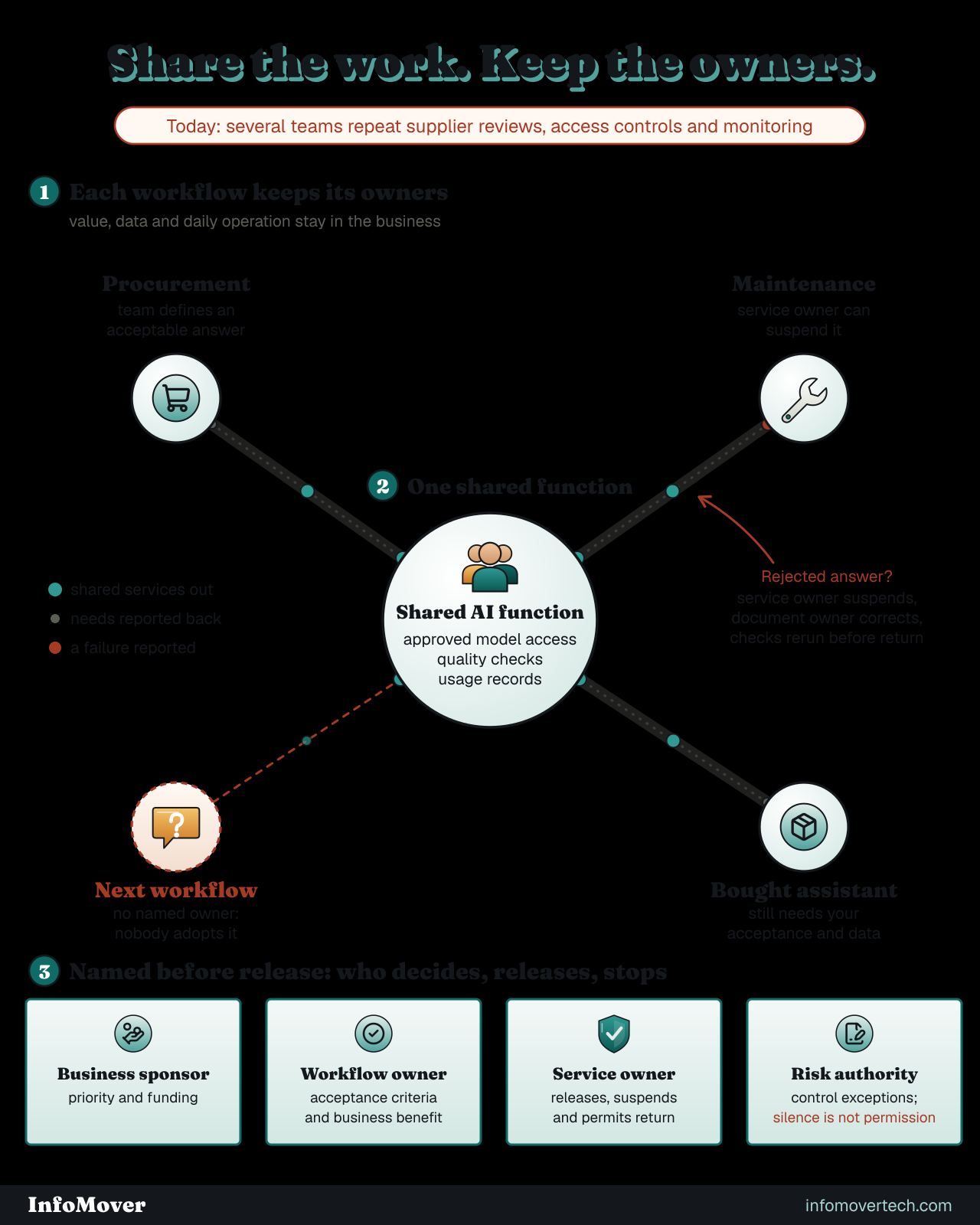
A third option is a shared foundation with departmental delivery. The central function supplies agreed services; local teams build and operate workflows using them. This is often called a federated model. AWS's discussion of AI operating models describes this combination of common foundations and components managed by business teams.
For example, you might share approved access to models, a method for running quality checks, and records of usage and failures. The procurement team would still define what an acceptable procurement answer looks like. Its document owners would still decide which procedures are authoritative and who may read them.
Choose this model only if local teams can carry their responsibilities. Each department must assign time for a workflow owner, document reviewers and service support. Where it lacks engineering capacity, name the team or supplier that will provide it. Confirm their support scope before release.
Give the shared team a concrete first delivery: for example, an approved route to model access and a reusable way to run quality checks for the first participating workflows. Name who maintains those services and who writes their usage and release requirements. If that team also builds a department's assistant, reserve support time for the shared services in its plan.
Write down who can decide, release and stop#
A workflow can remain stuck even when everyone agrees AI is useful. Someone must accept its quality, authorise its data use, fund its operation and decide whether it can continue when a problem appears.
The voluntary NIST AI Risk Management Framework 1.0 calls for clear responsibilities and communication, and assigns executive responsibility for AI risk decisions. Applying that principle here, name the decision owners before changing reporting lines. The framework's accountability outcomes leave room for different organisational structures.
The following is a proposed allocation to adapt to your existing authority structure:
| Decision or activity | Accountable role | Required contribution from others |
|---|---|---|
| Priority and funding for a workflow | Business sponsor | Delivery estimate, operating cost and risk assessment |
| Acceptance criteria and business benefit | Workflow owner | Subject experts define reference answers and review actual results |
| Permitted data and authoritative documents | Data owner | Security and relevant specialists assess access and handling |
| Shared infrastructure and its support | Shared service owner | Consuming teams provide capacity needs and report failures |
| Release of a particular workflow | Named service owner under delegated release authority | Business acceptance and required control sign-offs |
| A requested exception to a common control | Designated risk authority | Documented scope, consequence, compensating measures and expiry |
Give the shared function authority to enforce the controls it owns. Also state the limits of that authority. It should not silently accept a department's business risk, waive a data owner's restrictions or promise support outside its funded scope.
Set an escalation path for unresolved decisions, including who decides when owners disagree and how quickly they must respond. A pending exception remains pending until the authorised person decides; silence should never become permission to release.
Test the ownership split on one workflow#
Consider a hypothetical manufacturer whose procurement and maintenance departments want assistants for internal procedures. This is an illustrative scenario, not a client case.
Both departments need controlled access, a way to test answers and an operating record. A shared function provides those services. Each department selects its documents, supplies reference questions and names the person who accepts the resulting workflow.
Now a maintenance procedure changes. The assistant still uses the earlier version and returns an answer that a reviewer rejects. The immediate question is who can contain the affected workflow and get the source corrected.
In this scenario, staff following an outdated procedure could carry out work unsafely or outside the approved process.
Agree the response in advance. The maintenance service owner can suspend that workflow and direct staff to the approved manual process. The document owner supplies and approves the replacement procedure. The delivery team updates the application and reruns the agreed checks; the authorised service owner permits its return after the required acceptance. The shared function investigates whether its update mechanism failed and whether other workflows need checking.
That division makes the hand-offs testable. Ask the owners to walk through the example before release, showing where the document version, test results, suspension and return decision would be recorded. If the response ends with “the AI team will handle it”, identify the missing decision or service commitment.
The same exercise applies when you buy an assistant. Record which responsibilities the supplier accepts in the contract and which remain with your organisation. A managed product still needs your business acceptance, data decisions and incident contact.
Fund a charter you can evaluate#
The centre needs a deliverable and an operating budget. AWS's guidance on establishing a centre of excellence begins with executive sponsorship and a defined mission. For your approval, translate that mission into services a department can request and commitments someone can check.
For an initial charter, specify:
- The workflows and departments it will support, and the work outside its scope.
- The shared service it will deliver first, with a named owner and funded capacity.
- The evidence required for onboarding, release and a control exception.
- The support route, response commitments and authority to suspend affected work.
- The review date and the conditions for expanding, changing or closing the function.
You could review the initial charter after eight weeks. That is an illustrative planning period. Choose one that lets your teams complete and observe representative work. Record the starting position before introducing the shared service.
Measure time spent waiting for decisions and effort spent repeating implementation work. Check whether released workflows use the common service, carry the required release evidence and receive the promised support. Compare similar work and explain changes in scope. Completing a simpler task faster does not, by itself, establish improvement.
Count the shared function's own cost and the effort departments still supply. If the function adds approval delays, misses its service commitments or creates components nobody adopts, revise its remit before expanding it. The review should lead to a funding decision supported by delivery and control evidence.
What this means for you#
You can begin with named responsibilities and a small shared service inside your existing structure. Create a dedicated centre when recurring demand and the authority required justify it. Ask its proposed owner to list the first service, the people who will build and support it, and the work they must defer. Have each participating department commit a workflow owner and subject experts to acceptance testing and document upkeep.
Ask an external partner to leave your organisation with a usable charter, an ownership table and evidence from a working hand-off. Retain internal owners for business outcomes and risk decisions. An advisory assignment can help define the model; delivery and support need their own agreed scope.
Before approving more platform work, ask which real workflow will consume it and who commits to operating both parts. That connects the organisational decision to a service the business can use.
Questions to ask before funding an AI centre of excellence#
- Which repeated work or unresolved decision requires a shared owner?
- Will the function set standards, operate services, deliver workflows, or carry a defined combination?
- Who owns each workflow's benefit, documents, acceptance and daily operation?
- Which decisions can departments make themselves, and who approves exceptions?
- Who can suspend a workflow, correct its inputs and authorise its return?
- What capacity and support remain the department's responsibility, including when we buy a product?
- What evidence at the charter review would justify expansion, a narrower remit or closure?
For a consulting engagement to define the charter and test those responsibilities on a real workflow, Discuss your project.